Why you need an SRES®
A Seniors Real Estate Specialist (SRES) is a REALTOR who is uniquely qualified to assist seniors in housing sales and purchases.
My mission as a SRES® is to help seniors and their families navigate the challenges that accompany a home sale. The SRES® designation is awarded only to REALTORS® who have additional education on how to help seniors and their families with later-in-life real estate transactions. I am familiar with local community resources and services and have experience drawing on a network of expert senior specialists, such as estate planners, CPAs, and elder law attorneys.

The idea of moving can be a stressful time for a family—the amount of information and decisions may seem overwhelming. I understand that and I take the time to get to know you and your family’s situation, helping provide an outcome that best suits your needs. The added value of an SRES® professional network
For seniors, selling a home—one of life’s most valuable assets—and managing a subsequent move often require unique expertise. By working with an SRES®, you also get the benefit of specialists across a wide array of financial, legal, property, and personal services—from estate planning to downsizing—who can help with considerations in a sale and move, such as: Ways to use the home’s equity to allow a senior to remain in their home, if preferred. How to protect assets prior to listing. Showing the home in its best light. Moving needs—downsizing, senior-specialized moving, estate sale planning, and storage. Identifying potential legal issues and referring professional support—from estate planning to closings. When there is not already a trusted attorney or accountant, I can refer attorneys, estate planners, financial planners, and tax advisors, each with experience in elder issues. I also actively participate in senior and community service organizations and can provide referrals to resources such as Meals on Wheels, public benefit offices, transitional services coaches, grief counselors, and other services, as needed.

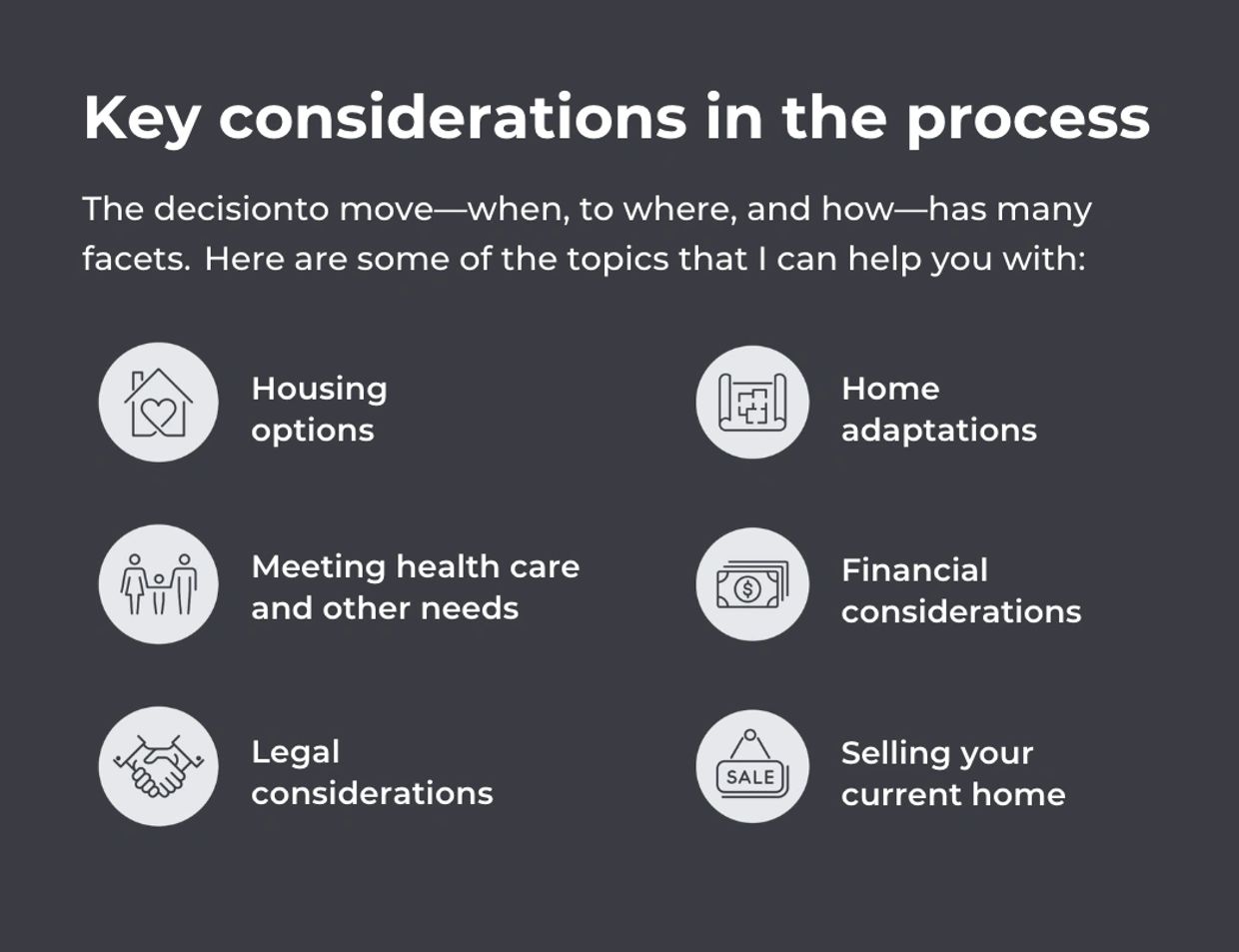
I can help you navigate this process by:
Familiarizing you with the types of senior housing available in the area. Suggesting important questions to ask when visiting various housing options. Creating connections with experts to clarify and compare actual costs for each option, assess affordability, and review legal agreements involved in the process. Suggesting a geriatric care manager to help determine needs.

What to Consider Before Starting the Process
Informing Relevant Family of a Possible Sale & Its Reasons
Family members can have a strong emotional stake in the sale; some may not want to say goodbye to the home. A family talk about the decision to sell before signing commitments can help prevent future misunderstandings and avoid delays in the process.
Having One Family Member Take the Lead
When family members are involved in the sales process, it’s best to have one person take the lead in communicating with the me and other professionals; multiple contacts can create confusion and cause delays.
When a Family Member is Acting on Your Behalf
If a family member—often an adult child—would need the authority to make legally binding decisions regarding the home, a durable power of attorney document must be in place naming that individual to act on your behalf.
Tax Consequences of a Sale
Selling a home can trigger significant taxation. So, before listing a home, it’s a good idea to consult a tax specialist or professional financial advisor to determine how a sale will affect your finances. An SRES® can provide you with a list of referrals if you don’t have an advisor.
Your Trusted Real Estate Partner
Some seniors may choose to stay in their current home. Others may consider moving to an adult child’s home. For many others, the choice of senior housing may be the best direction.
Housing Options

Retirement or Age-Constricted Communities
Designed for older adults who are physically able to care for themselves, including cooking and personal care. Residency is often restricted to adults aged 55 and older; additional restrictions Usually composed of single-family homes, townhomes, condominiums, or apartments. May offer basic services like housecleaning, laundry, and transportation, but seldom offer medical care or more involved support services. Often accept pets and often built using universal design guidelines, making them handicapped-accessible.

Assisted Living Arrangements
Provide seniors with support services in a community setting. Accept residents who may have medical problems but do not need continuous skilled nursing care. Encourage residents to maintain their independence, while also offering them access to professional medical care and support services when needed. Offer an array of health care and personal services, including assistance with daily living activities such as bathing, grooming, and dressing. Usually apartments but can be personal care group homes or single-family homes providing “board and care.” Generally offer a wide assortment of activities, clubs, and transportation to personal appointments, religious services, cultural events, and shopping malls. Often accept pets and often provide meals.

Continuing Care Retirement Communities
Represent a “continuum of care” approach, offering a spectrum of senior living options, including independent living, assisted living units, and continuous nursing care facilities, typically in close proximity to one another. May also offer a secure and supervised environment for individuals with various degrees of memory impairment. Allow residents to enter at any level of care with an assurance that, if their health or faculties decline, they will be moved to the next level of care when needed, through to continuous care. May require significant entry fees, parts of which may or may not be refunded if the resident passes away. Are usually occupied on a rental basis, though some have ownership arrangements. Typically have rather complex contracts due to the levels of service offered and provisions for transitioning between them.
Your Trusted Real Estate Partner

Nursing Homes
Provide 24-hour care for people with chronic illnesses. Often resemble a hospital setting. Have doctors on staff, though nurses administer most patient monitoring and medical care. May have physical and occupational therapists on staff. Are more expensive because they provide full-time professional care. Are seldom covered by Medicare or most health insurance plans (may be covered by Medicaid for those who qualify or by long-term care insurance). Are required to meet standards set by the federal government. May be run for profit or by not-for-profit groups such as religious or community organizations.
About Nelson Family Real Estate Team

How to Choose the Right Senior Housing
Determine Level of Care Needed
Most housing choices are driven by care requirements: Can the senior take care of most of their personal needs but would enjoy having housecleaning, laundry, and meal services? Would medication management, an emergency response system, and on-premises nursing provide the senior and family with more peace of mind? Does the senior need assistance with bathing, grooming, and dressing? Are there concerns about memory issues? A senior’s needs will change over time. I can refer a geriatric care manager who can help you determine the types of care needed.
Examine Financial Resources
Housing and long-term care costs can tap much of a senior’s savings, and as needs change, budgeting can be difficult. Elder law attorneys and financial planners can help seniors and their families allocate resources to pay for housing and care. They are also experts in Medicare and Medicaid law and will know which expenses are or aren’t covered by each program.
Visit Senior Housing Options
I can guide you to listing sites and other resources that categorize local facilities by level of care provided. Check licensing and accreditation for any facilities you are considering. Then visit and tour those that appear to fit your needs, asking questions and talking with families who are visiting loved ones there.
Review Any Contract with an Eldercare Attorney Before Signing
Housing contracts involving long-term care can be complex. When selecting a facility, an eldercare attorney can identify potential issues with a contract and help you resolve those prior to signing.